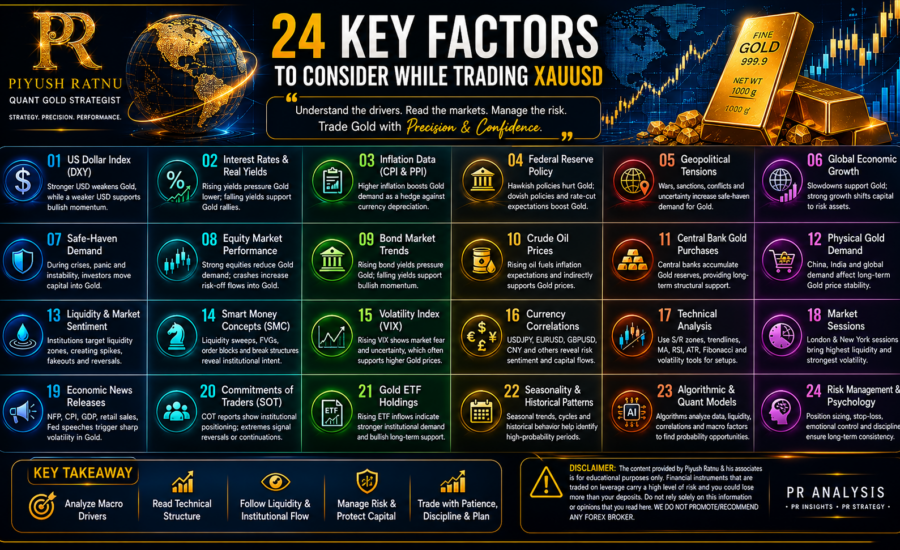
24 Key Factors to Consider While Trading XAUUSD
1. US Dollar Index (DXY)
The US Dollar Index is one of the strongest correlations affecting XAUUSD. Gold generally moves inversely to the Dollar because Gold is priced in USD globally. When the Dollar strengthens, Gold becomes more expensive for foreign buyers, reducing demand. A weak Dollar usually supports bullish momentum in Gold markets.
2. Interest Rates & Real Yields
Gold is a non-yielding asset, making interest rates extremely important. Rising US Treasury yields and real yields increase the opportunity cost of holding Gold, often pressuring prices lower. Falling yields typically support Gold rallies as investors seek alternative stores of value.
3. Inflation Data (CPI & PPI)
Inflation reports such as CPI and PPI heavily influence Gold volatility. Higher inflation increases demand for Gold as a hedge against currency depreciation and purchasing power erosion. Unexpected inflation spikes often create strong bullish reactions in XAUUSD.
4. Federal Reserve Policy
Federal Reserve statements, FOMC meetings, and monetary policy expectations directly impact Gold prices. Hawkish policies strengthen the USD and pressure Gold, while dovish policies and rate-cut expectations usually support bullish Gold momentum.
5. Geopolitical Tensions
Wars, sanctions, military conflicts, banking crises, and political uncertainty increase safe-haven demand for Gold. Geopolitical fear often triggers aggressive institutional buying in XAUUSD during periods of global instability.
6. Global Economic Growth
Economic slowdowns and recession fears usually support Gold because investors seek safer assets during uncertainty. Strong economic growth can shift capital toward equities and reduce safe-haven demand for Gold.
7. Safe-Haven Demand
Gold is historically viewed as a safe-haven asset. During financial panic, stock market crashes, or banking instability, investors often move capital into Gold to preserve wealth and reduce portfolio risk.
8. Equity Market Performance
Indices such as the S&P 500 and NASDAQ influence Gold sentiment. Strong stock market rallies often reduce Gold demand, while equity market crashes can increase risk-off flows into XAUUSD.
9. Bond Market Trends
US Treasury markets strongly influence Gold price behavior. Rising bond yields usually pressure Gold lower, while falling yields support bullish momentum by reducing the attractiveness of fixed-income assets.
10. Crude Oil Prices
Oil prices impact inflation expectations and global economic sentiment. Rising Oil prices often increase inflation fears, indirectly supporting Gold demand as an inflation hedge.
11. Central Bank Gold Purchases
Central banks globally accumulate Gold reserves to diversify away from fiat currencies. Large-scale central bank buying provides long-term structural support to Gold prices.
12. Physical Gold Demand
Demand from major Gold-consuming nations such as China and India significantly affects long-term Gold stability. Festival seasons, jewelry demand, and economic conditions influence physical buying activity.
13. Liquidity & Market Sentiment
Institutional liquidity drives modern financial markets. Large players often target liquidity zones where retail traders place stop losses, creating sudden volatility spikes and fakeouts before major moves.
14. Smart Money Concepts (SMC)
Concepts such as liquidity sweeps, Fair Value Gaps (FVGs), order blocks, and breaker structures help traders understand institutional positioning and probable reversal zones in XAUUSD.
15. Volatility Index (VIX)
The VIX measures market fear and uncertainty. Rising VIX levels often support Gold prices as investors seek protection against broader financial market volatility.
16. Currency Correlations
Currencies such as USDJPY, EURUSD, GBPUSD, and CNY provide insight into global risk sentiment and capital flows. USDJPY, in particular, often shows strong inverse or correlated behavior with Gold volatility.
17. Technical Analysis
Support and resistance zones, moving averages, RSI, ATR, Fibonacci retracements, and trend structures remain essential tools for identifying high-probability trade setups in Gold markets.
18. Market Sessions
The London and New York trading sessions generate the highest liquidity and volatility in Gold. Traders monitor session overlaps carefully because institutional activity is strongest during these periods.
19. Economic News Releases
Events such as NFP, CPI, GDP, retail sales, unemployment claims, and Fed speeches create sharp volatility spikes in Gold markets. Professional traders carefully manage risk during high-impact news events.
20. Commitments of Traders (COT) Report
The COT report reveals institutional positioning in Gold futures markets. Extreme long or short positioning can signal potential reversals or continuation trends.
21. Gold ETF Holdings
Gold ETF inflows and outflows reflect institutional investor sentiment. Rising ETF holdings generally indicate stronger investment demand and bullish long-term support for Gold.
22. Seasonality & Historical Patterns
Gold often exhibits recurring seasonal behavior influenced by central bank activity, festival demand, year-end positioning, and macroeconomic cycles. Historical patterns help traders identify recurring volatility structures.
23. Algorithmic & Quantitative Models
Modern Gold markets are heavily influenced by algorithmic trading systems that analyze volatility, liquidity, macroeconomic data, intermarket correlations, and institutional order flow in real time.
24. Risk Management & Psychology
Even the best analysis fails without discipline and proper risk management. Position sizing, stop-loss placement, emotional control, and patience are essential for long-term survival and consistency in Gold trading.
RISK DISCLOSURE | Verified Track Record | Connect on Telegram | Instagram | X.com | MQL5