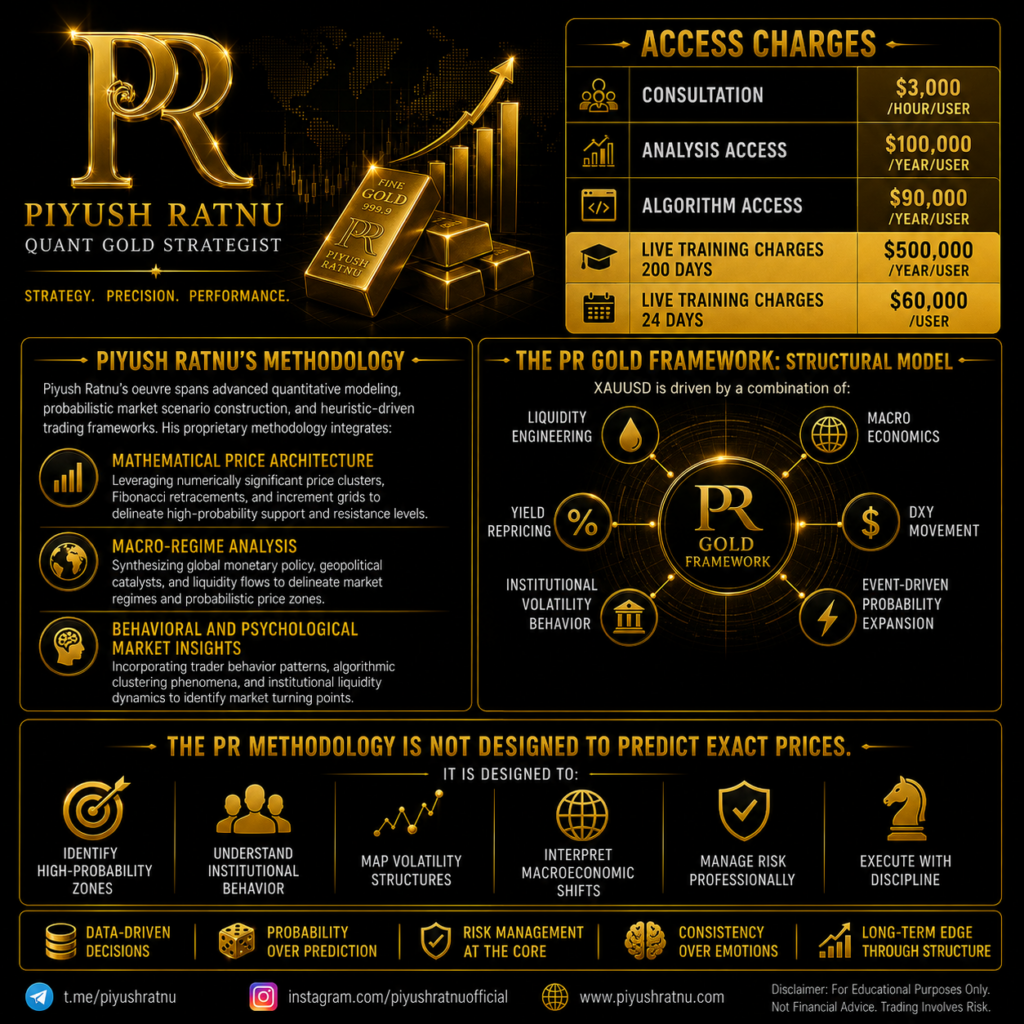
Piyush Ratnu’s oeuvre spans advanced quantitative modeling, probabilistic market scenario construction, and heuristic-driven trading frameworks. His proprietary methodology integrates:
Mathematical Price Architecture – Leveraging numerically significant price clusters, Fibonacci retracements, and increment grids to delineate high-probability support and resistance levels.
Macro-Regime Analysis – Synthesizing global monetary policy, geopolitical catalysts, and liquidity flows to delineate market regimes and probabilistic price zones.
Behavioral and Psychological Market Insights – Incorporating trader behavior patterns, algorithmic clustering phenomena, and institutional liquidity dynamics to identify market turning points.
Ratnu’s analytical acumen is complemented by his ability to codify complex market constructs into practical, executable strategies, bridging the divide between theoretical rigor and operational application. He has consistently provided high-conviction forecasts across XAU/USD and related commodities, frequently outpacing contemporaneous market consensus.
Endowed with a rare combination of quantitative sophistication and intuitive market foresight, Ratnu is positioned to contribute exceptional value in the context of hedge fund strategy formulation, portfolio optimization, and risk-managed alpha generation.
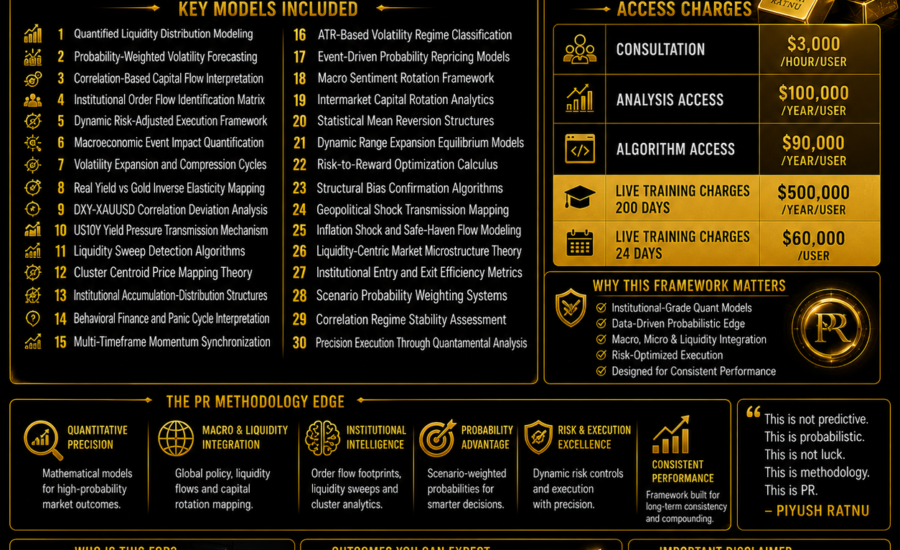
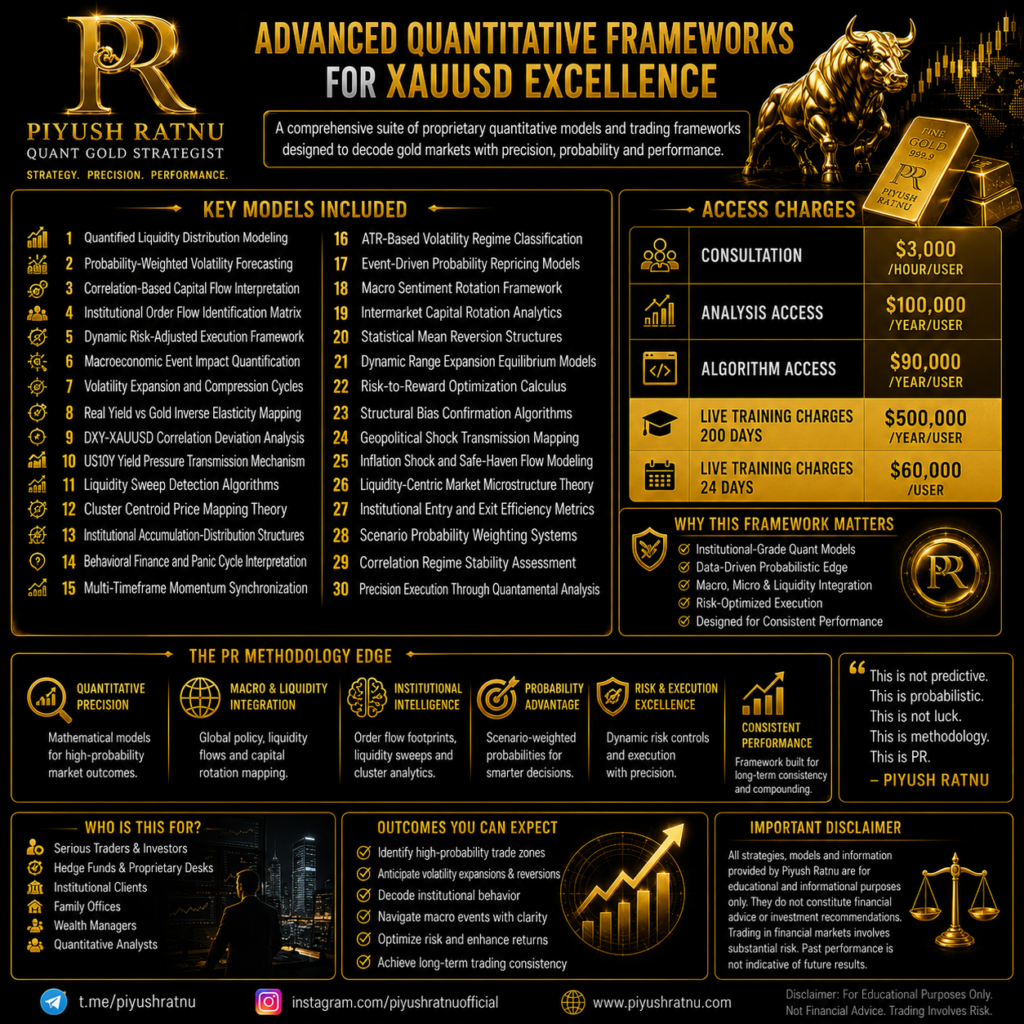
LIVE Training Charges: 200 Days $500,000/year/user
LIVE Training Charges: 24 Days $60,000/user
The Architect of the “Golden Falcon” XAUUSD Framework
In the modern era of macro-driven financial markets, few independent analysts have built a niche identity around a single instrument as strongly as Piyush Ratnu. Known primarily for his deep specialization in XAUUSD (spot gold), Ratnu has emerged as a recognized name in the field of event-driven gold-market analysis, probability-based forecasting, and structured liquidity mapping.
From 2020 through 2026, his analytical journey evolved from discretionary gold trading into a sophisticated “quantamental” framework — a hybrid model combining quantitative structures, macroeconomic interpretation, institutional liquidity concepts, and algorithm-assisted probability analysis. This evolution became increasingly visible during one of the most volatile periods in modern financial history, marked by pandemic stimulus cycles, inflation shocks, aggressive Federal Reserve tightening, geopolitical conflicts, oil-market disruptions, and central-bank gold accumulation.
At the center of Ratnu’s methodology lies what has become known as the “Golden Falcon Algorithm” — a structured framework designed to analyze XAUUSD through intermarket correlations, event-risk volatility, liquidity clusters, and macroeconomic probabilities
The PR Gold Framework: Structural Model
XAUUSD is driven by a combination of:
Liquidity engineering
Macro economics
Yield repricing
DXY movement
Institutional volatility behavior
Event-driven probability expansion
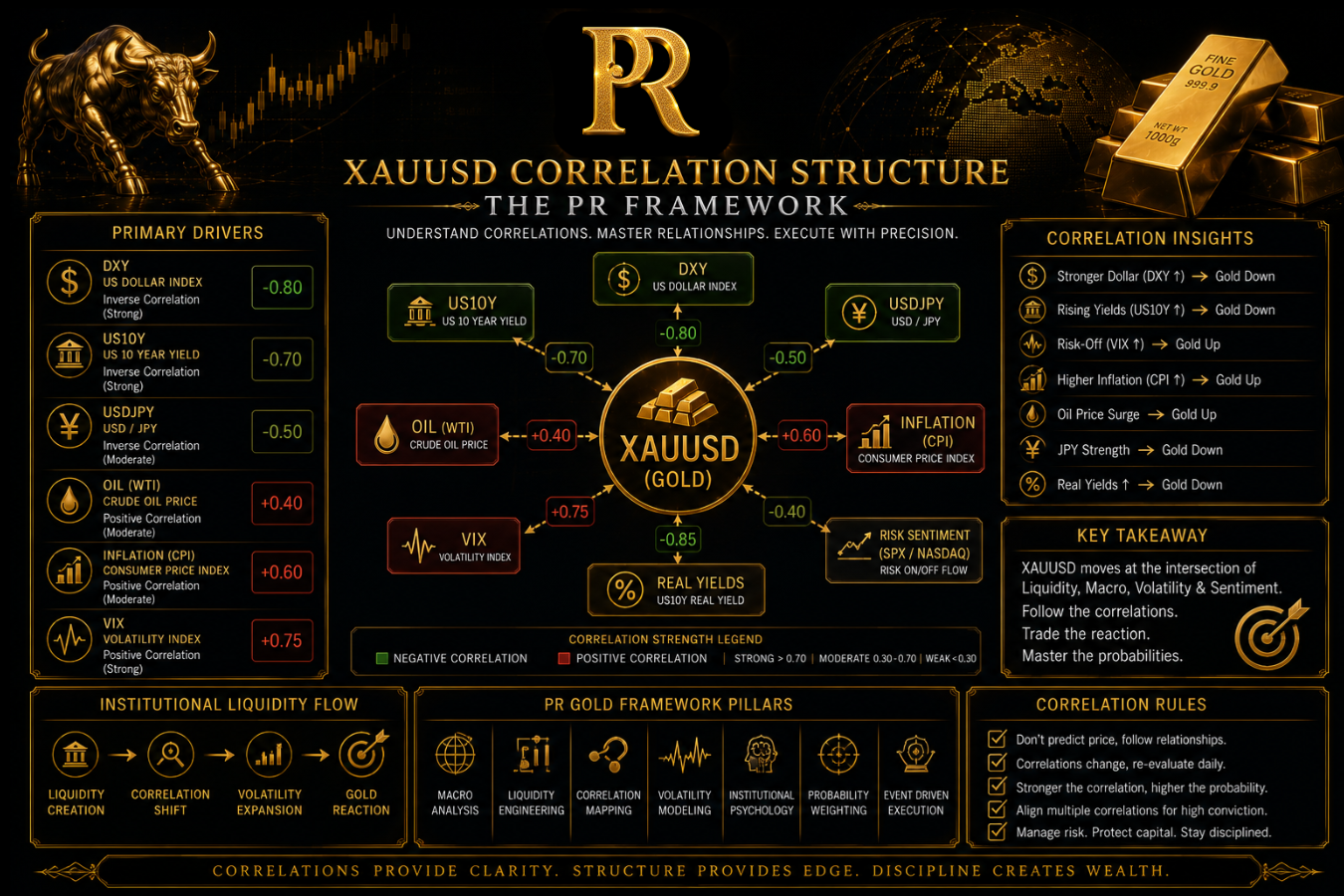
The PR Gold Framework operates through:
Macro analysis
Liquidity engineering
Correlation mapping
Volatility modeling
Institutional psychology
Probability weighting
Event-driven execution
The PR methodology is not designed to predict exact prices.
It is designed to:
Identify high-probability zones
Understand institutional behavior
Map volatility structures
Interpret macroeconomic shifts
Manage risk professionally
Execute with discipline
The market rewards:
Patience
Structure
Probability management
Emotional discipline
Liquidity awareness
Quantamental Liquidity Engine for XAUUSD
Its core principles are:
Gold trades through macro regimes
Liquidity matters more than indicators
Correlations dominate trend direction
Volatility expands during events
Institutional behaviour repeats
Probability matters more than prediction
Repeating clusters act as reaction zones
Gold cannot be analyzed independently from DXY and yields
Event-driven volatility creates the highest opportunity
Mathematical Core of the PR Framework
The reconstructed mathematical model from the sheet analysis was:
Cluster Centroid Model
XAUUSD OHLC prices
Volume
DXY (US Dollar Index)
US10Y Treasury Yields
USDJPY
Session timing
Volatility regimes
Liquidity sweeps
Return calculations
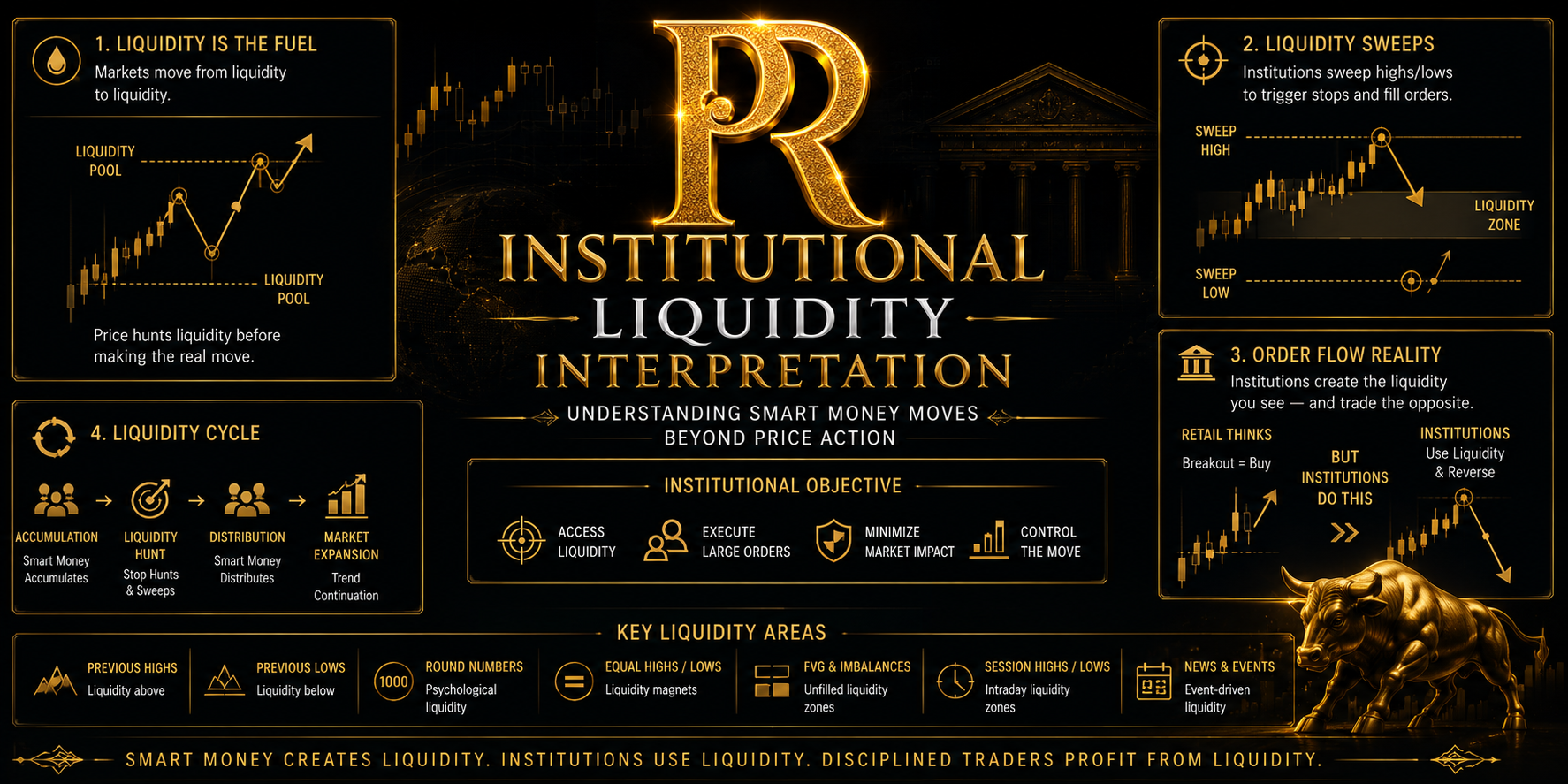
Institutional Liquidity Interpretation
Markets frequently sweep highs/lows before direction
Gold reacts around volatility clusters
Institutional entries occur during panic volatility
Reversal probability increases after liquidity extraction
The “High Sweep” and “Low Sweep” columns attempted to classify these institutional behaviors.
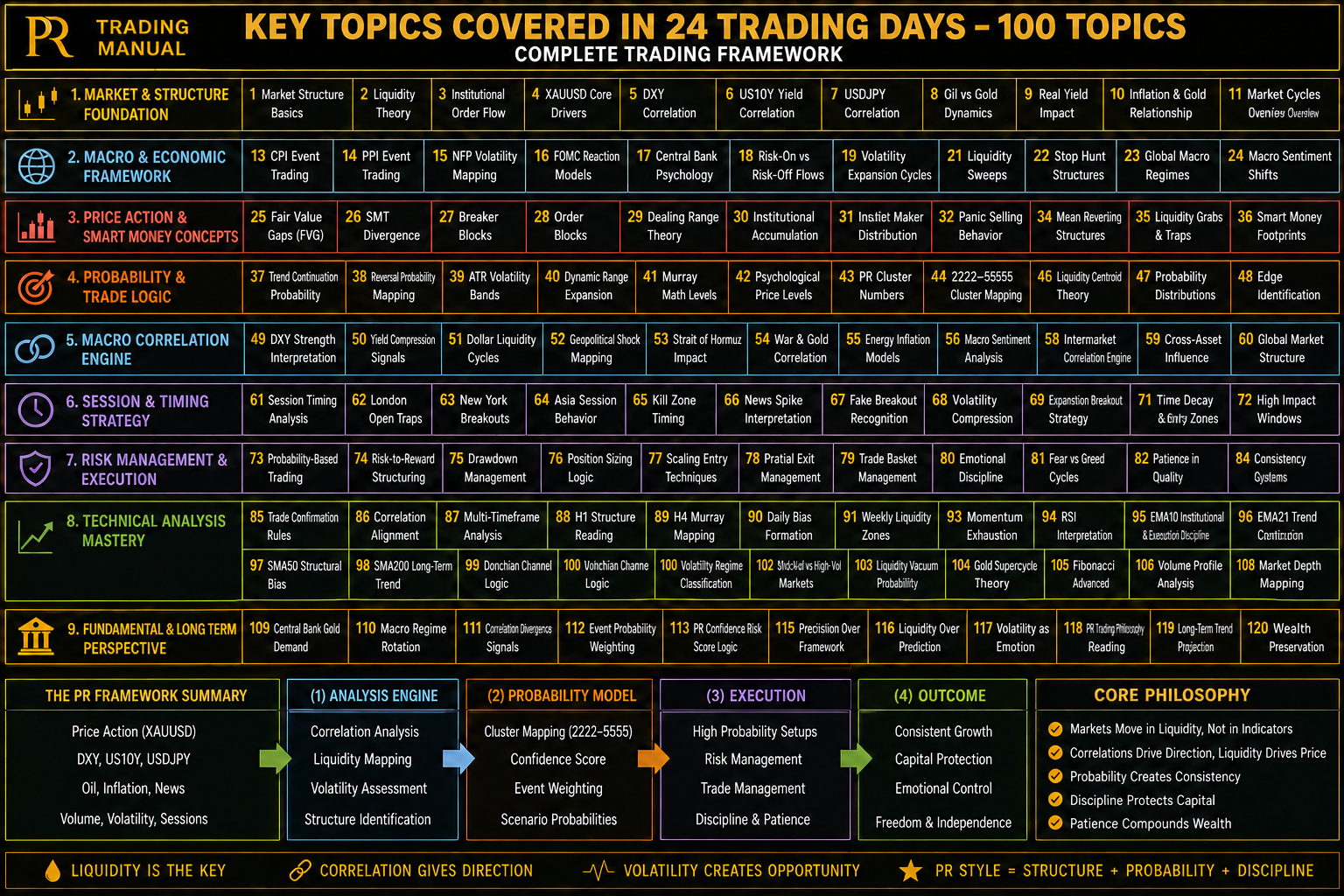
KEY TOPICS COVERED IN 24 TRADING DAYS
Access & LIVE Training Charges: $60,000/month/user
PR Trading Manual – 100 Core Topics
Market Structure Basics
Liquidity Theory
Institutional Order Flow
XAUUSD Core Drivers
DXY Correlation
US10Y Yield Correlation
USDJPY Correlation
Oil vs Gold Dynamics
Real Yield Impact
Inflation & Gold Relationship
CPI Event Trading
PPI Event Trading
NFP Volatility Mapping
FOMC Reaction Models
Central Bank Psychology
Risk-On vs Risk-Off Flows
Safe Haven Dynamics
Volatility Expansion Cycles
Liquidity Sweeps
Stop Hunt Structures
Fair Value Gaps (FVG)
SMT Divergence
Breaker Blocks
Order Blocks
Dealing Range Theory
Institutional Accumulation
Institutional Distribution
Market Maker Behavior
Panic Selling Structures
Mean Reversion Logic
Trend Continuation Probability
Reversal Probability Mapping
ATR Volatility Bands
Dynamic Range Expansion
Murray Math Levels
Psychological Price Levels
PR Cluster Numbers
2222–5555 Cluster Mapping
Liquidity Centroid Theory
Correlation Regime Filters
DXY Strength Interpretation
Yield Compression Signals
Dollar Liquidity Cycles
Geopolitical Shock Mapping
Strait of Hormuz Impact
War & Gold Correlation
Energy Inflation Models
Oil Shock Volatility
Macro Sentiment Analysis
Intermarket Correlation Engine
Session Timing Analysis
London Open Traps
New York Breakouts
Asia Session Behavior
Kill Zone Timing
News Spike Interpretation
Fake Breakout Recognition
Volatility Compression
Expansion Breakout Strategy
Institutional Entry Zones
Probability-Based Trading
Risk-to-Reward Structuring
Drawdown Management
Position Sizing Logic
Scaling Entry Techniques
Partial Exit Management
Trade Basket Management
Emotional Discipline
Fear vs Greed Cycles
Patience in Trading
Trade Confirmation Rules
Correlation Alignment
Multi-Timeframe Analysis
H1 Structure Reading
H4 Murray Mapping
Daily Bias Formation
Weekly Liquidity Zones
Trend Strength Evaluation
Momentum Exhaustion
RSI Interpretation
EMA10 Institutional Momentum
EMA21 Trend Continuation
SMA50 Structural Bias
SMA200 Long-Term Trend
Donchian Channel Logic
Volatility Regime Classification
Mid-Vol vs High-Vol Markets
Shock Event Probability
Liquidity Vacuum Moves
Gold Supercycle Theory
Central Bank Gold Demand
Macro Regime Rotation
Correlation Divergence Signals
Event Probability Weighting
PR Confidence Score Logic
Institutional Risk Framework
Precision Over Prediction
Liquidity Over Emotion
Volatility as Opportunity
PR Trading Philosophy & Execution Discipline
The PR Model and Algorithm help traders analyze markets through structured probability, correlation intelligence, and liquidity interpretation rather than emotional prediction. By integrating XAUUSD price action, DXY, US10Y yields, USDJPY, volatility regimes, macroeconomic events, and institutional liquidity behavior, the framework identifies high-probability trading zones with disciplined risk parameters. The model transforms complex market data into actionable decision structures, allowing traders to interpret volatility, anticipate liquidity sweeps, and understand institutional positioning with greater precision. Instead of chasing random market movements, traders develop a systematic approach based on probability weighting, macro correlation mapping, execution discipline, and volatility engineering for long-term consistency and professional decision-making.
 From 2020 through 2026, his analytical journey evolved from discretionary gold trading into a sophisticated “quantamental” framework — a hybrid model combining quantitative structures, macroeconomic interpretation, institutional liquidity concepts, and algorithm-assisted probability analysis. This evolution became increasingly visible during one of the most volatile periods in modern financial history, marked by pandemic stimulus cycles, inflation shocks, aggressive Federal Reserve tightening, geopolitical conflicts, oil-market disruptions, and central-bank gold accumulation.